
Iran’s President Delivers Dual Message of Resistance and Diplomacy at UN General Assembly
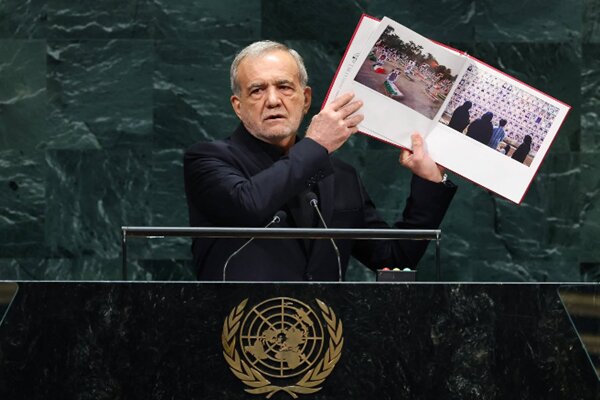
According to the International Desk of Webangah News Agency, The United Nations General Assembly provided a distinct platform for Iranian President Masoud Pezeshkian’s third appearance, serving not only as a venue for articulating Tehran’s official positions but also as a stage where the rhetoric of both Iran and the United States was presented to global public opinion before detailed analysis in their respective capitals.
Pezeshkian took the podium on Wednesday, October 1, amidst simultaneous global focus on conflict, negotiations, sanctions, regional security, and the future of international order. Consequently, the significance of his address transcended mere statements; what the world perceived from his remarks and which aspects were highlighted by foreign media and officials are of greater importance.
An examination of these reactions reveals that Pezeshkian’s speech cannot be solely characterized as an official stance from Tehran; it conveyed messages regarding war and peace, Iran’s relationship with the world, and the image the Islamic Republic of Iran seeks to project during one of the region’s most volatile periods.
What message did the world receive from Pezeshkian’s words?
The initial interpretation by foreign media of Pezeshkian’s address was a blend of steadfastness and readiness for diplomacy, indicating that Tehran rejects American threats while not entirely closing the door to negotiations. Reuters, in its report on the President’s speech, juxtaposed these two aspects, noting that Pezeshkian stated Iran would not surrender to U.S. pressure but was prepared for diplomacy to end the conflict. Al Jazeera also emphasized this point in its assessment, describing Pezeshkian’s speech as a combination of sharp criticism of Trump’s approach and an affirmation of the possibility of negotiation. Thus, the initial foreign reading interpreted Tehran’s message not as a “rejection of negotiation,” but as negotiation without surrender and without accepting threatening language.
A more significant takeaway pertains to the rationale behind Tehran’s simultaneous firm tone and continued diplomacy. Andreas Krieg, a professor of Defence Studies at King’s College London, regards this apparent contradiction as part of the “narrative war” between Tehran and Washington. According to this analyst, the U.S. aims to portray any potential agreement as a result of its pressure on Iran, while Tehran needs to demonstrate that it has resisted pressure and entered negotiations while maintaining its leverage. From this perspective, Pezeshkian’s speech is not merely a statement for a foreign audience but an effort to shape a narrative where negotiation is not equated with retreat. This foreign interpretation highlights one of the most crucial layers of Pezeshkian’s remarks: his deliberate avoidance of creating a dichotomy between “resistance” and “diplomacy.”
Other foreign analyses shifted focus from Tehran-Washington relations to regional security and the Strait of Hormuz. Al Jazeera reported that while emphasizing diplomacy, Pezeshkian placed the issue of maritime blockade and Hormuz at the core of Iran’s positions. Concurrently, reports from the New York negotiations indicate that Hormuz is a primary point of contention between the two sides. Tehran seeks the lifting of economic pressures and blockades, while Washington insists on freedom of navigation in this waterway.
Therefore, when Pezeshkian states, “Either we will build security together, or we will tolerate insecurity together,” this statement can be understood in the context of an issue now identified in foreign analyses as a key knot in the crisis: should Persian Gulf security be defined by the presence and pressure of foreign powers, or by arrangements where regional countries play a primary role?
Even before the speech, regional and Western media had taken note of this aspect of Tehran’s message. The National reported that coinciding with Pezeshkian’s visit, Iranian security officials spoke of the possibility of combining negotiation with military preparedness, proposing regional security arrangements involving Iran and Persian Gulf countries, rather than relying solely on Washington.
Meanwhile, Al Jazeera had previously written about the Iran-U.S. conflict, noting that some Persian Gulf Cooperation Council countries, amid ongoing security concerns, were engaging with Tehran to mend relations and establish new cooperation. Consequently, Pezeshkian’s statement about jointly building security can be seen as part of a broader message whose audience, in the view of some foreign media, is not just the United States but also the Arab countries of the region.
One of the most significant foreign takeaways from Pezeshkian’s speech was Tehran’s effort to avoid creating a contradiction between resistance and diplomacy. The Guardian, in its analysis, wrote that while Pezeshkian repeatedly emphasized Iran’s non-surrender, he simultaneously announced Tehran’s readiness for dialogue, diplomacy, and negotiation without the “language of force.”
This interpretation gains greater importance considering that mere hours before the speech, the first direct contact between Iranian officials and U.S. envoys in months had occurred through intermediaries. Reuters described these discussions as a sign of potential progress, albeit without overt shifts in either side’s positions.
Furthermore, the Strait of Hormuz has become a key to understanding Pezeshkian’s message in foreign media interpretations. Reuters reported that Hormuz is currently a major point of divergence between Tehran and Washington, and Pezeshkian emphasized at the UN that not everyone can expect to benefit from this waterway while Iran is deprived of access to shipping.
The Guardian offered a similar interpretation, suggesting that Pezeshkian in New York sought to garner support from Iran’s Arab neighbors for Tehran’s proposals regarding the future of Hormuz. Consequently, his statement, “Either we will build security together, or we will tolerate insecurity together,” can be interpreted in foreign media analyses not merely as a stance on Iran’s security but as a message to the Arab states of the Persian Gulf concerning the future of regional security arrangements.
Why was reopening the Palestinian issue necessary?
One aspect highlighted in foreign media coverage of Pezeshkian’s speech was the linkage of Iran’s crisis with the Palestinian issue and the crisis of legitimacy of the international order.
Pezeshkian did not present the Palestinian issue merely as a separate matter in Iran’s foreign policy but rather as an example of the failure of international mechanisms to prevent civilian suffering, emphasizing that one cannot speak of peace while ignoring Palestine. The Guardian, in its live coverage of the speech, juxtaposed this section with Pezeshkian’s warning about the spread of war, reporting that he described the situation in Palestine as an “open wound” on the conscience of the international community and a symbol of the failure of international mechanisms to prevent civilian suffering.
From the perspective of some Israeli media, however, this part of Pezeshkian’s remarks was interpreted differently. The Jerusalem Post focused intently on his criticism of the double standard in dealing with the nuclear capabilities of Iran and Israel. Pezeshkian stated at the UN that Iran does not seek nuclear weapons but will not relinquish its right to peaceful nuclear technology, while questioning why Israel possesses nuclear weapons while Iran faces pressure and sanctions. The Times of Israel also highlighted this segment, writing that Pezeshkian emphasized maintaining the right to enrichment and peaceful nuclear technology in his speech.
These reactions indicate that in the interpretation of Israeli media, the nuclear aspect of Pezeshkian’s speech was a central point of his message—a message where Tehran attempts to draw a clear line between rejecting nuclear weapons and rejecting limitations on its peaceful nuclear program.
In addition to this issue, American media placed Pezeshkian’s remarks on Palestine within the broader context of regional crises. The Associated Press reported that Middle East wars cast a shadow over the General Assembly, with issues such as the Iran-U.S. conflict, Gaza, and the Israeli-Palestinian dispute at the center of UN discussions. The Los Angeles Times described Pezeshkian’s speech as one delivered in a wartime environment, where the Iranian president, while defending Tehran’s positions, warned against continued conflict, disruption to shipping, and the failure of negotiations.
From this viewpoint, raising the Palestinian issue in Pezeshkian’s speech cannot be seen as a mere repetition of a traditional stance; he sought to make Palestine a test case for the international community’s claims regarding peace, international law, and the protection of civilians.
Overall, the foreign reflection of this part of the speech indicates that Pezeshkian attempted to advance his message on two simultaneous levels: first, defending Iran’s position on war, its nuclear program, and the right to defense; and second, placing these issues within a larger framework of the Palestinian crisis and double standards in the application of international law.
This is where his statement, “Either we will build security together, or we will tolerate insecurity together,” acquires a broader meaning. Because, in Pezeshkian’s narrative, lasting regional security is not solely an issue between Iran and the United States. Without resolving the Palestinian issue and ending what he considers the selective application of international rules, achieving lasting peace in West Asia is impossible.


